Couples finances
How to split expenses based on income as a couple
Learn how to split bills based on income with a simple formula, a worked example, and a clear comparison between 50/50 and proportional splitting.

When two partners earn different amounts, splitting every shared expense 50/50 does not always create the same financial burden for both people.
One alternative is to split bills based on income.
The idea is simple: each partner contributes according to the percentage of the household income they earn.
For example, if one person earns $4,000 per month and the other earns $2,000, they represent roughly 66.7% and 33.3% of the combined income.
If their shared monthly expenses are $1,800, a proportional split would be:
- Partner A: $1,200
- Partner B: $600
Let's walk through the calculation and look at when this approach may make sense.
How to calculate an income-based split
Start by adding both monthly incomes.
For example:
- Alex earns $4,000 per month.
- Sam earns $2,000 per month.
Combined household income:
$4,000 + $2,000 = $6,000
Now calculate each person's percentage of that total.
For Alex:
4,000 ÷ 6,000 = 66.67%
For Sam:
2,000 ÷ 6,000 = 33.33%
Then apply those percentages to the shared expenses.
If shared expenses are $1,800:
- Alex contributes 66.67%: $1,200
- Sam contributes 33.33%: $600
The general formula is:
Individual contribution = total shared expenses × individual income percentage
Worked example: $4,000 income vs $2,000 income
Here is the full calculation:
| Alex | Sam | |
|---|---|---|
| Monthly income | $4,000 | $2,000 |
| Share of household income | 66.67% | 33.33% |
| Total shared expenses | $1,800 | $1,800 |
| Proportional contribution | $1,200 | $600 |
| Share of personal income used for shared expenses | 30% | 30% |
This last row is why some couples prefer proportional splitting.
The dollar amounts are different, but both partners are putting the same percentage of their income toward shared expenses.
50/50 vs proportional: what actually changes?
Using the same example:
- Alex earns $4,000.
- Sam earns $2,000.
- Shared expenses are $1,800.
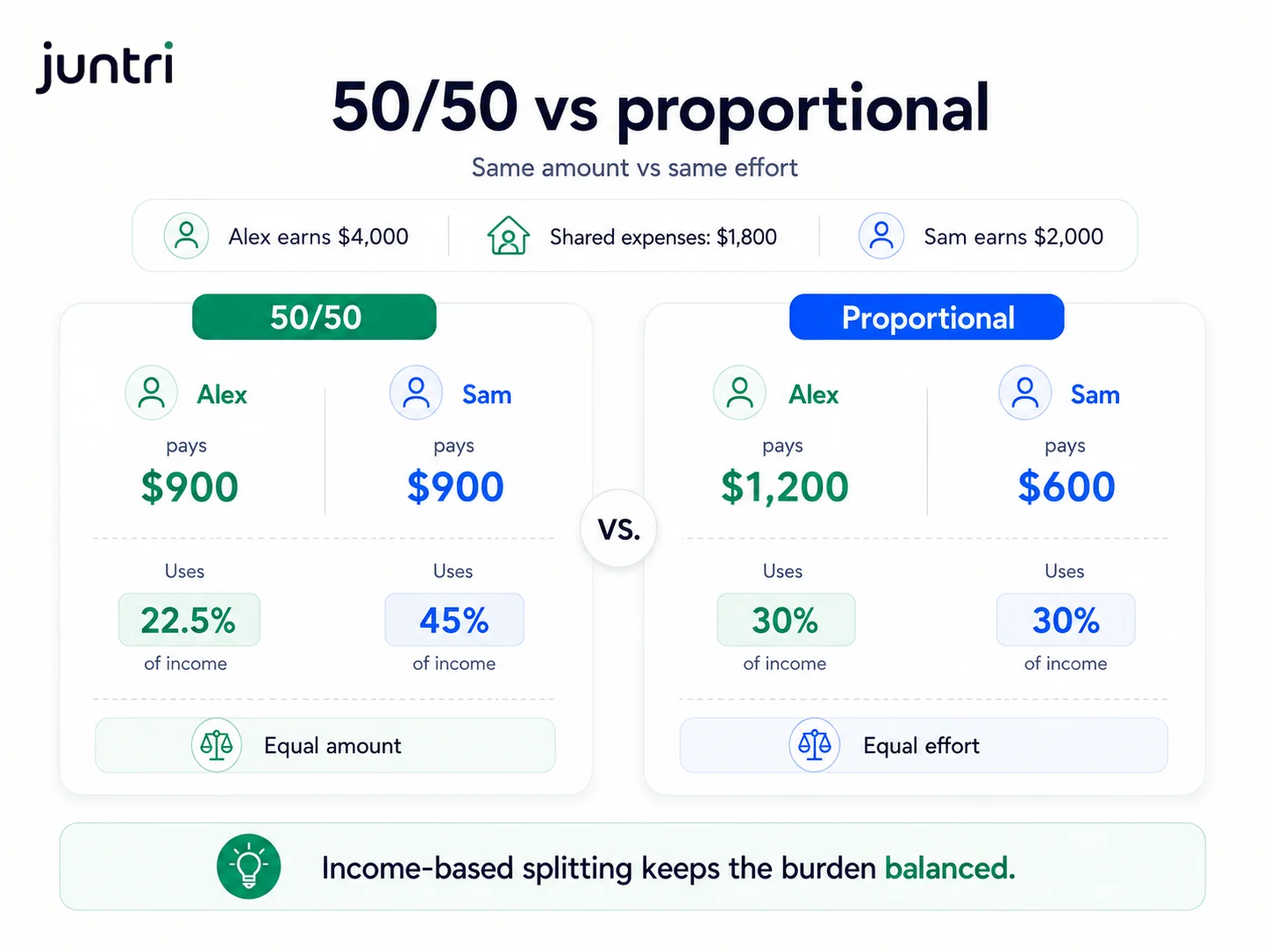
With a 50/50 split:
- Alex pays $900.
- Sam pays $900.
They pay the same amount, but the burden is different.
Alex uses:
22.5% of their income
Sam uses:
45% of their income
With proportional splitting:
- Alex pays $1,200.
- Sam pays $600.
Both contribute:
30% of their income
This does not mean proportional splitting is always better.
A 50/50 arrangement may work perfectly well when incomes are similar and both partners are comfortable with it.
An income-based split can be useful when there is a meaningful income gap and both people want shared expenses to represent a similar proportion of their available income.
Should you use gross income or take-home pay?
For day-to-day budgeting, take-home pay is usually the more practical number.
That means the amount actually available after taxes and mandatory deductions.
For example, if a person's salary is $5,000 before deductions but only $4,000 reaches their bank account, using $4,000 may better reflect what they can actually spend.
The most important thing is that both partners use the same method.
If one person uses gross income and the other uses take-home pay, the percentages will not be comparable.
Which expenses should be included?
Before calculating percentages, decide what actually counts as a shared expense.
Common shared expenses may include:
- rent or mortgage;
- utilities;
- groceries;
- internet;
- household supplies;
- insurance;
- childcare;
- shared transportation;
- agreed couple activities.
Not every expense has to be shared.
Personal expenses may include:
- clothing;
- hobbies;
- personal subscriptions;
- individual debt;
- gifts;
- personal transportation;
- purchases that only benefit one person.
There is no universal list.
The important part is agreeing on which expenses belong to the household and which remain personal.
Is proportional splitting always the fairest option?
Not necessarily.
A formula can help organize money, but it cannot define fairness for every relationship.
Some couples prefer:
- 50/50;
- proportional splitting;
- assigned bills;
- a joint account;
- fully combined finances;
- a hybrid of several methods.
A hybrid approach can be especially practical.
For example:
Split proportionally
- rent;
- utilities;
- groceries.
Split 50/50
- restaurants;
- entertainment;
- travel.
Or keep certain expenses completely separate.
What matters is choosing a rule that both people understand and can sustain.
What happens when each person pays different expenses during the month?
This is where the simple percentage calculation stops being enough.
Suppose you already agreed that:
- Alex should contribute $1,200.
- Sam should contribute $600.
But during the month they do not transfer those exact amounts into a shared account.
Instead, they pay different bills.
Alex pays:
- rent: $900
- groceries: $300
- internet: $150
Total paid by Alex:
$1,350
Sam pays:
- electricity: $150
- groceries: $100
- dinner: $200
Total paid by Sam:
$450
Now compare what each person should have contributed with what they actually paid.
| Alex | Sam | |
|---|---|---|
| Expected contribution | $1,200 | $600 |
| Actually paid | $1,350 | $450 |
| Difference | +$150 | -$150 |
Alex paid $150 more than their agreed share.
Sam paid $150 less.
So the final adjustment is simple:
Sam owes Alex $150.
This is the part that becomes difficult when there are 20 or 30 expenses instead of six.
How to keep track throughout the month
You can use a spreadsheet.
For example, create columns for:
- date;
- expense;
- amount;
- who paid;
- who shares the expense;
- each person's share.
Then compare how much each person should contribute with how much they actually paid.
Another option is to use a shared expense tracker.
The important distinction is this:
how much someone should contribute
is not always the same as
how much they actually paid.
Keeping both numbers clear makes the final settlement much easier.
When should you recalculate the percentages?
You do not necessarily need to recalculate the split every month.
But it may be worth reviewing when:
- someone gets a raise;
- one partner changes jobs;
- someone temporarily loses income;
- you move in together;
- major household expenses change;
- you have children;
- one person's income changes significantly.
Some couples simply review the arrangement whenever there is a meaningful financial change.
The percentage is a tool, not a permanent rule.
Frequently asked questions
Is 50/50 fair if one partner earns more?
It can be, if both partners are comfortable with the arrangement.
But when incomes differ significantly, equal dollar contributions can represent very different percentages of each person's income.
That is why some couples choose an income-based split.
How do you calculate bills based on income?
Add both incomes together.
Then divide each person's income by the combined income to calculate their percentage.
Apply those percentages to the shared expenses.
For example, if one person earns 60% of the household income, they would contribute 60% of the shared expenses under a proportional system.
Should couples split rent based on income?
Some couples do, especially when there is a large income difference.
Others use 50/50 or another arrangement.
Rent is often one of the largest shared expenses, so it is worth agreeing on a method that both people can comfortably maintain.
Should you use gross or net income?
Take-home or net income is often easier for household budgeting because it reflects the money actually available after mandatory deductions.
The key is using the same definition for both partners.
What if one partner has no income?
A strict proportional formula could assign 100% of shared expenses to the person earning income.
That does not mean every couple should use the formula that way.
Temporary unemployment, caregiving, education, health, or other circumstances may require a different arrangement.
Do all expenses need to use the same percentage?
No.
You can use different rules for different categories.
For example, rent and utilities might be proportional while entertainment stays 50/50.
The percentage is only the beginning
Splitting expenses based on income answers one important question:
How much should each person contribute?
But everyday life creates another question:
Who actually paid what?
During a month, one person may pay rent, the other may cover groceries, someone pays internet, and dozens of smaller shared expenses appear.
That is why the useful comparison is not only:
66.7% vs 33.3%
It is:
expected contribution vs actual payments.
Once you keep track of both, settling shared expenses becomes much easier.